
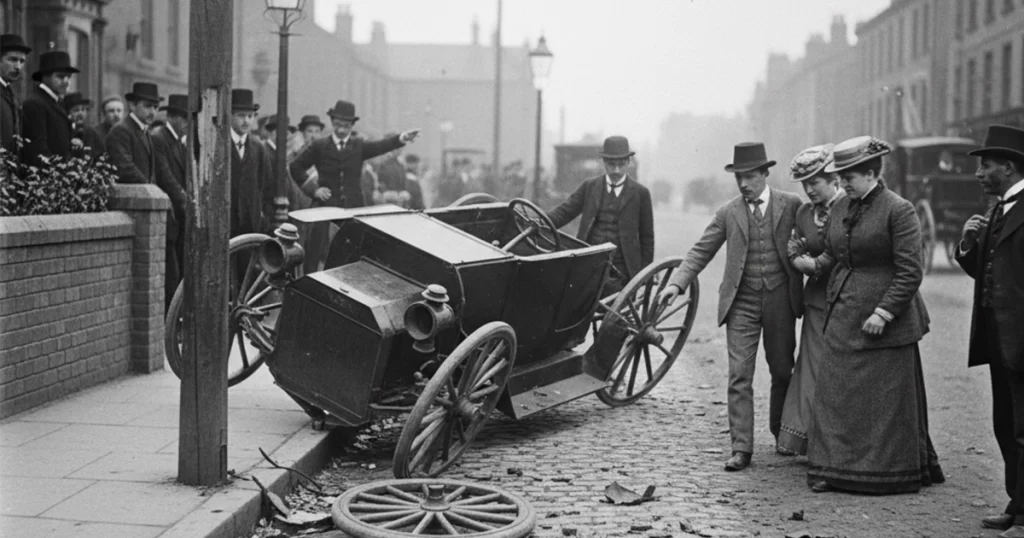
If you search for the first car accident, you’ll often find one simple date and story, but the reality is more complicated. Early crashes were poorly documented, and even defining what counted as a “car” wasn’t consistent. Without modern traffic laws, police reports, or insurance systems, early accidents are difficult to pinpoint.
If you need one practical answer, 1869 (Mary Ward in Ireland) is the most widely recognized worldwide, while the first documented U.S. automobile accident occurred in 1891, when James William Lambert’s gasoline-powered car crashed in Ohio. There isn’t a single “first,” but several significant milestones, including the earliest crash stories, the first documented fatalities, and the first pedestrian deaths, help explain how modern accident laws evolved, something a Houston car accident lawyer often clarifies today.
Car Accident History
Early car accidents illustrate how vehicles, roads, and public safety have evolved, showing key incidents that shaped how we understand traffic risks today.
- 1771 – Cugnot vs. Wall: Allegedly the earliest crash story, where Nicolas-Joseph Cugnot, a French inventor, crashed a steam-powered vehicle into a wall.
- 1834 – Steam Carriage Explosion: A deadly steam-powered carriage crash near Glasgow, resulting in multiple fatalities.
- August 31, 1869 – Mary Ward: The first widely recognized automobile-style road death occurred in Ireland.
- 1891 – James William Lambert: The first documented U.S. automobile accident occurred in Ohio when Lambert’s gasoline-powered car hit a tree root and crashed into a hitching post. Both he and his passenger survived with minor injuries.
- August 17, 1896 – Bridget Driscoll: The first recorded pedestrian motor-car death in Britain, marking a turning point in public awareness of motor vehicle dangers.
- September 1899 – Henry H. Bliss: The first recorded U.S. motor vehicle fatality, killed in New York City by an electric-powered taxi.
Why the “First Car Accident” Is Hard to Pin Down
Pinpointing the first car accident is difficult because early vehicles, records, and definitions varied greatly. Steam-powered prototypes, inconsistent documentation, and differing standards for what counted as a “car” make the timeline unclear. Historians treat early crashes as milestones rather than one definitive event.
- Early vehicles weren’t standardized cars: Many early machines were steam-powered prototypes, experimental road engines, or hybrid vehicles that don’t fit today’s definition of an automobile.
- Crash reporting barely existed: Long before traffic police, insurance claims, or accident reports, many crashes went undocumented, or were recorded years later through secondhand accounts.
- Definitions vary: Some historians count any self-propelled road vehicle, while others only consider passenger vehicles that resemble modern cars.
First Often-Cited Car Crash: 1771 (Cugnot)
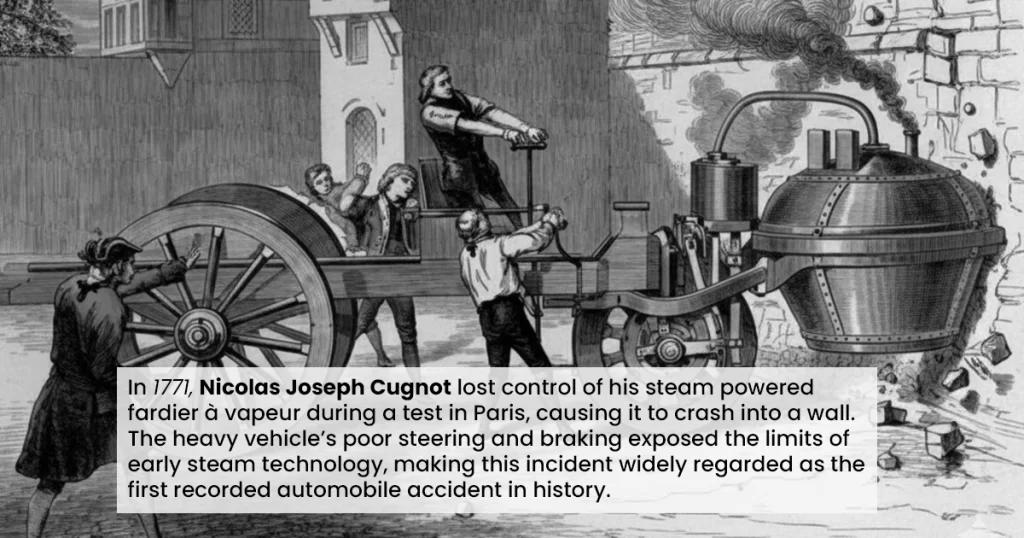
One of the earliest and most cited car crash stories involves Nicolas-Joseph Cugnot, a French inventor who built a steam-powered military vehicle. In 1771, Cugnot allegedly lost control and collided with a wall in Paris, often labeled the first car accident. While widely repeated, contemporary records are limited, and the story appears mainly in later historical accounts. Historians generally describe it as:
- The earliest widely repeated automobile crash story
- Not the most reliably documented crash, but it highlights early vehicle control challenges
First Fatal Motor Vehicle Accident: 1834
A stronger candidate for the first documented fatal motor vehicle accident occurred in 1834 near Glasgow, Scotland, often linked to the Glasgow–Paisley route. Accounts describe a steam carriage overturning after hitting an obstruction, causing a boiler explosion that killed several passengers and injured others. This incident is significant because:
- Multiple fatalities were reported (exact number varies by source).
- It draws a clear link between mechanical failure and the loss of life.
- It has better historical documentation than earlier crash stories.
This accident illustrates a major danger of early motor vehicles; crashes weren’t just collisions; they could quickly turn into mechanical disasters, making the safety of early vehicles even more crucial.
First Recognized Automobile-Style Road Death: 1869 (Mary Ward)
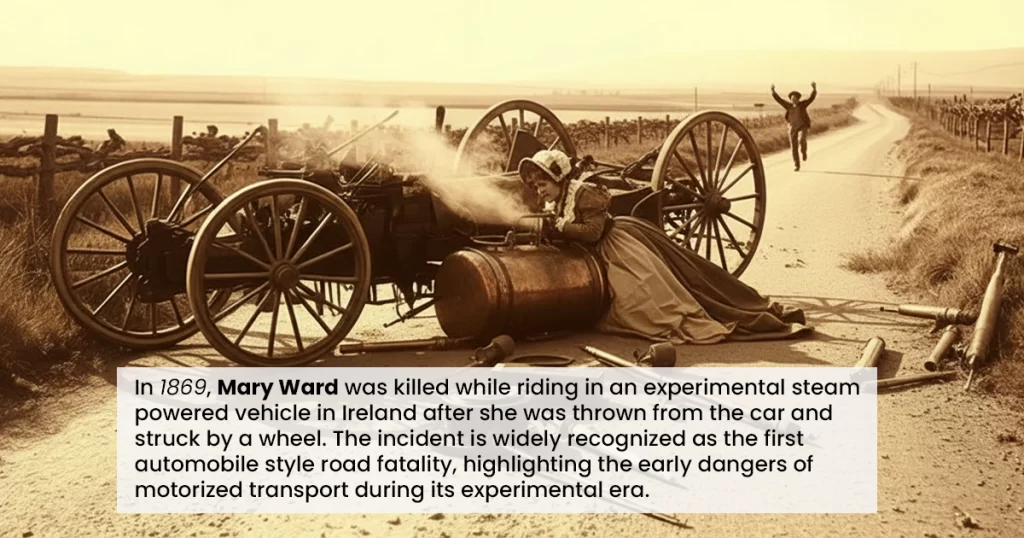
When historians are asked about the first true automobile accident death, they often point to Mary Ward. On August 31, 1869, Mary Ward, an Irish scientist and writer, was riding in an experimental steam-powered car built by her relatives in Parsonstown (now Birr), Ireland. The vehicle lost control, and Ward fell from the vehicle, was pulled under the wheels, and died from her injuries. Why does Mary Ward’s accident matter?
- It involved a passenger road vehicle, not a rail-adjacent machine.
- The circumstances resemble modern car accidents, such as a passenger falling from a moving vehicle and sustaining fatal injuries.
- The incident is well-documented and widely accepted.
For these reasons, Mary Ward is often cited as the first automobile-style road traffic fatality.
First Documented U.S. Automobile Accident: 1891 (James William Lambert)
Before the first recorded U.S. motor vehicle fatality in 1899, the earliest documented automobile accident in the United States occurred in 1891 in Ohio City, Ohio. Inventor James William Lambert was driving a single-cylinder gasoline-powered vehicle he helped develop when the car struck a tree root, veered off the road, and crashed into a hitching post. Lambert and his passenger suffered minor injuries, but the incident is widely recognized as the first recorded automobile accident in the U.S. This accident matters because:
- It involved a gasoline-powered automobile, not a steam prototype
- It occurred on a public roadway, not during a private experiment
- It marked the beginning of automobile accident history in the United States
When Car Accidents Became Public Headlines: 1896 (Bridget Driscoll)
By the late 1800s, motor vehicles were being demonstrated publicly, and accidents began attracting attention. On August 17, 1896, Bridget Driscoll was struck and killed at the Crystal Palace in London, highlighting the dangers of early cars. This incident is widely recognized as:
- The first recorded pedestrian killed by a motor car in Great Britain.
- A turning point in public awareness that even slow-moving vehicles could be deadly.
First Recorded U.S. Motor Vehicle Fatality: 1899 (Henry H. Bliss)
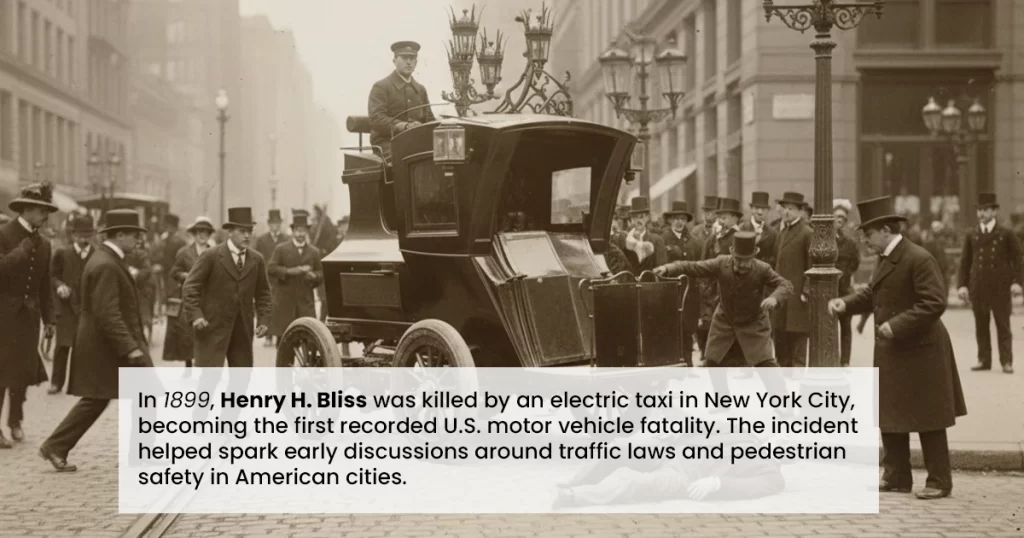
In the United States, Henry H. Bliss is widely cited as the first recorded motor vehicle fatality. On September 13, 1899, he stepped off a streetcar in New York City and was struck by an electric-powered taxicab, dying the next day. This incident is recognized as:
- The first recorded motor vehicle fatality in the U.S.
- An early example showing that safety risks existed regardless of whether vehicles were powered by gas or electricity
Why These Early Car Accidents Still Matter Today
Modern car accident law exists because society had to learn, often painfully, how to live alongside machines that move faster than people. Early automobile accidents shaped everything we now take for granted:
- Traffic laws were developed in response to injuries and deaths.
- Speed limits emerged after pedestrian fatalities.
- Licensing and vehicle standards followed public concern.
- Liability rules evolved as accidents became unavoidable.
What Victims Faced Before the Car Accident Law Existed
Before modern car accident law existed, victims had little to no legal protection:
- No standardized traffic rules.
- No insurance coverage.
- No formal accident investigation.
- No medical compensation system.
- No car accident lawyers or auto accident attorneys.
Families often had no legal remedy at all. The structured car accident claim process we rely on today only emerged as crashes became more frequent and impossible to ignore.
What Happens Today After a Car Accident in Texas
Today, car accidents are governed by clearer laws, but insurance companies still work to minimize payouts. In a modern Texas car accident claim, outcomes often depend on:
- Early documentation.
- Medical evidence.
- Proof of fault.
- Understanding comparative negligence rules.
If injuries are serious or liability is disputed, working with a Houston car accident lawyer or Houston auto accident attorney can help protect your rights and pursue fair compensation for medical bills, lost income, and long-term effects.
Get Help After a Texas Car Accident
If you’ve been involved in a car accident in Texas and aren’t sure how to proceed, an experienced team can guide you through the insurance process and help protect your legal rights. They ensure that every step, from documentation to communication with insurers, is handled correctly.
Reach out to The Law Office of Keivan S. Romero, a trusted Houston car accident lawyer, to discuss your accident and understand your next steps for pursuing fair compensation and protecting your interests.